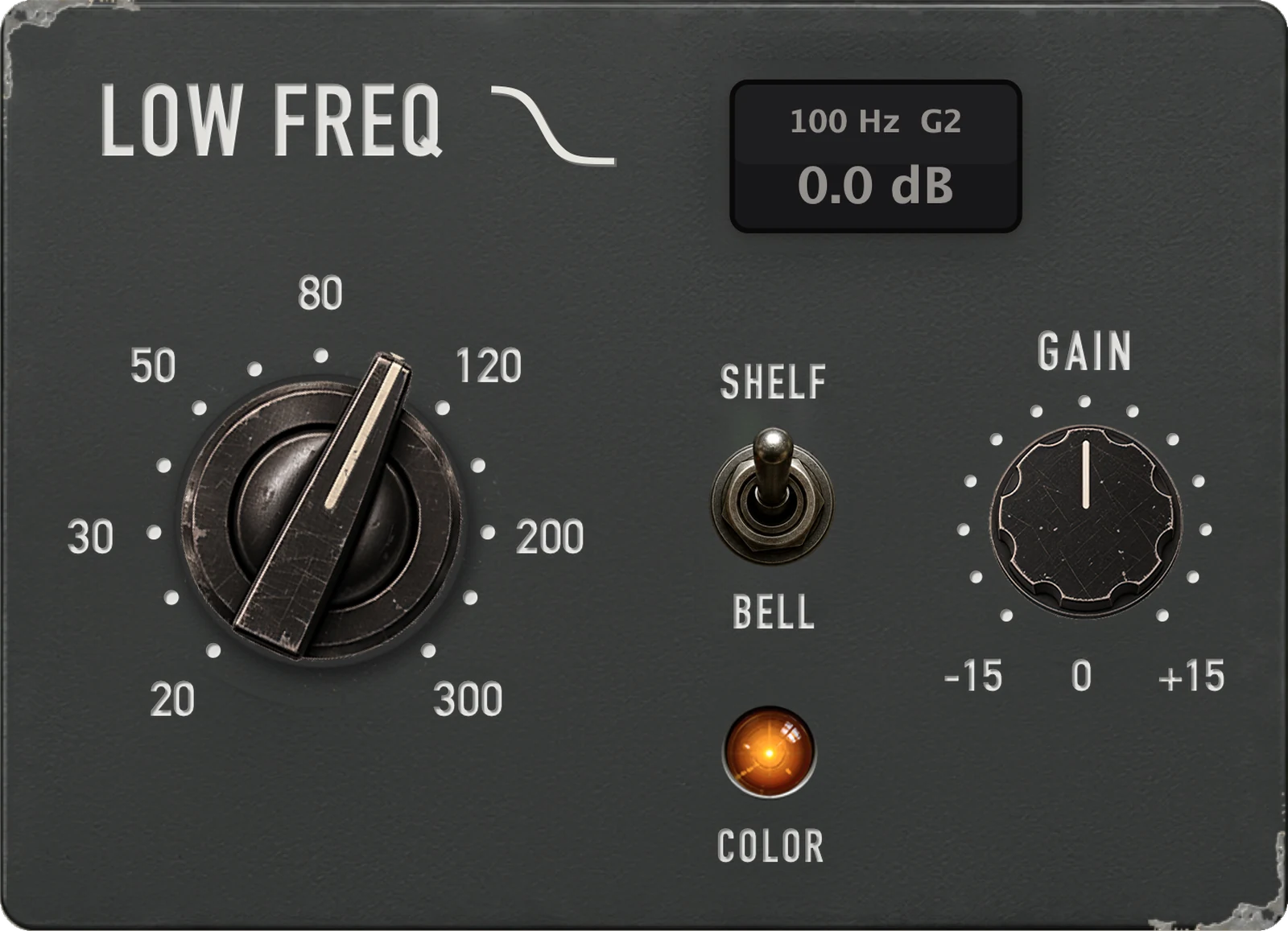
LOW · SHELF100 Hz · +12 dB and +6 dB
Set to 100 Hz · G2 at +12 dB, the lift peaks at 82 Hz · E2. The sub gets 10.9 dB: punch over the sub, not mud.
Tone Coloring EQAU · VST3
Tone, with a pulse.
SALTA EQ56 is a tone-coloring equalizer built to shape weight, presence, harmonics and clarity.


01Sounds
Real material through SALTA EQ56. Before is the untouched excerpt, after is what came out, matched in loudness: what changes is the tone, not the level.
What SALTA EQ56 changed · after minus before
02SALTA EQ56
SALTA EQ56 is not designed to simply make an EQ curve. It is designed to change how a sound feels: the weight under a bass, the air over a vocal, the way a drum bus sits forward without getting louder.
Three bands, one row. Low, mid and high each carry a frequency knob, a gain knob and a SHELF / BELL switch. The switch does not just change the shape of a curve, it picks the whole topology of the band. Frequency knobs lock onto the printed marks, so the pointer and the mark it points at can never disagree, and every move shows up in the value window as hertz, note name and signed decibels.
Under each band sits a COLOR lamp. Engaged, the band builds an explicit harmonic layer and adds it on top of the signal. Nothing is subtracted from the clean path and the band's own fundamental stays where it was, so the character comes up without the note draining away. Three lamps, three voices, from a hint of warmth on a vocal to an obvious grind on a bus.
CLARITY, the second lamp on the high band, opens the top of the stereo picture: the sides get a lift, the middle gives a little back, and the top end widens without turning brittle. EQ IN is a crossfaded bypass rather than a hard cut, so you can flip it under programme material, compare, and nothing clicks. CONTROL trims the output, twin VU meters read what leaves, and 26 factory presets ship inside, filed by category, with your own saved next to them.
03Measured
Each band's response and the COLOR stages' harmonics, measured through the plug-in. Not a picture of the idea.
Set to 100 Hz · G2 at +12 dB, the lift peaks at 82 Hz · E2. The sub gets 10.9 dB: punch over the sub, not mud.
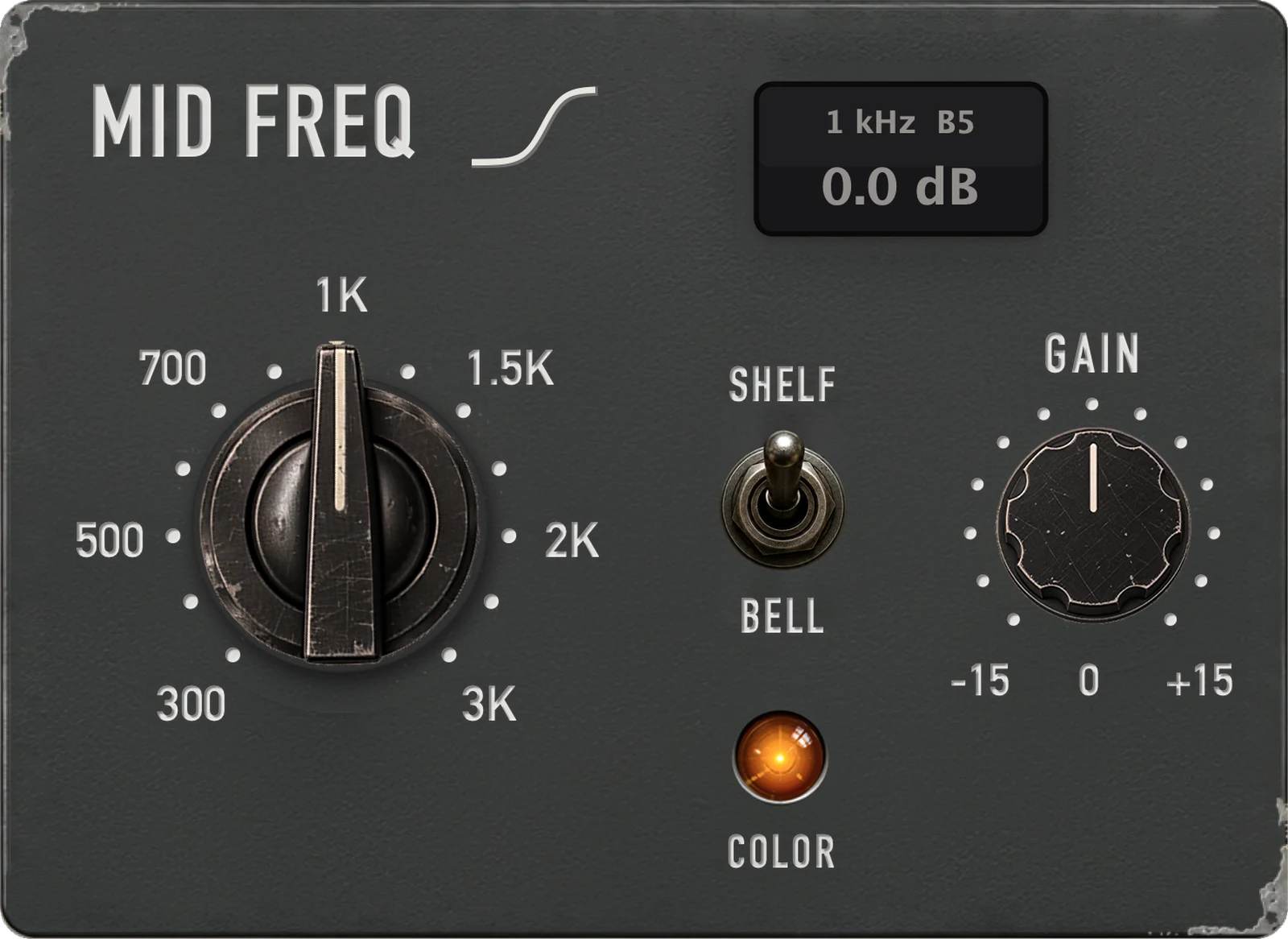
The bell peaks on its own centre: 1 kHz set, 1 kHz lifted. With its lamp on, a little weight under the mud and a little edge off 2-3 kHz.
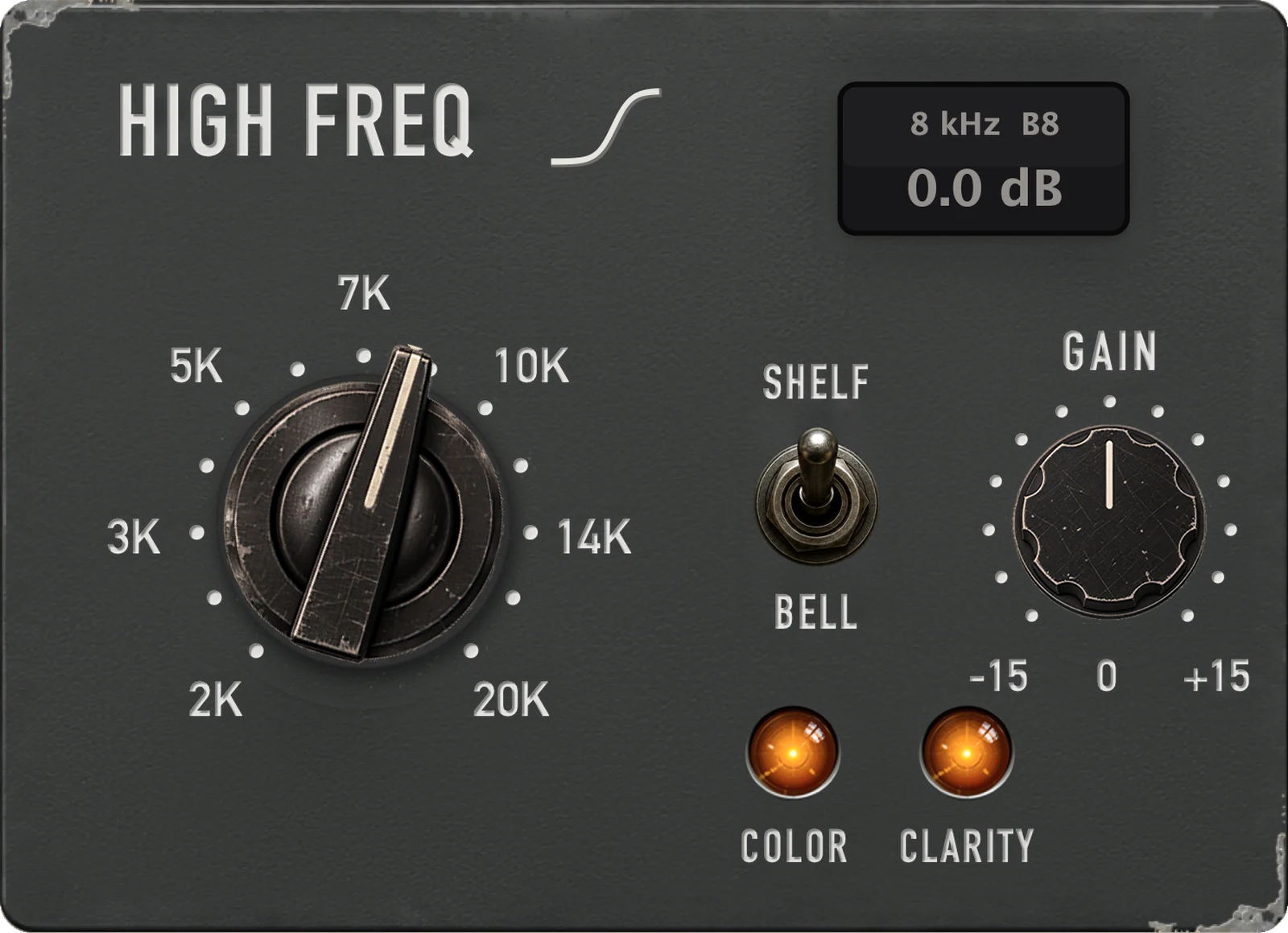
A boost is a parallel branch: the top opens rather than just getting louder. CLARITY works on the sides; a hard-left source leaves the right at -121 dBFS.
The harmonic layer sits on top of the clean signal. The second harmonic falls 12.8 dB for every 12 dB the level drops, the way a valve does; the lamps are loudness-matched (+0.4 / +0.5 / +0.2 dB on), so nothing is louder-is-better.
04At a glance

Low band, 20–300 Hz. Shelf or bell. The knob locks on the printed marks, so what you see is where it sits.
Mid band, 300 Hz–3 kHz. Shelf or bell topology, not just a curve shape.
High band, 2–20 kHz. On SHELF a boost is a parallel branch that opens the top rather than just making it louder.
One COLOR lamp per band. Engaged, the band adds a harmonic layer on top of the EQ. Nothing is taken away from the clean signal.
CLARITY opens the top of the stereo picture: the sides get a lift, the middle gives a little back.
EQ IN is a true bypass with a short crossfade, so it can be flipped under programme material without a click.
Output trim, with its value printed under the word while it is off zero.
Twin meters reading what leaves the plug-in, after the trim.
Each band shows its frequency, the nearest note to the cent, and its gain. LOW on SHELF also names the note actually being lifted.
05The details · Purchase
Technical notes
06Reviews
Reviews are open to everyone. Bought it? Your review carries a verified mark.
Reviews
There are no reviews yet.